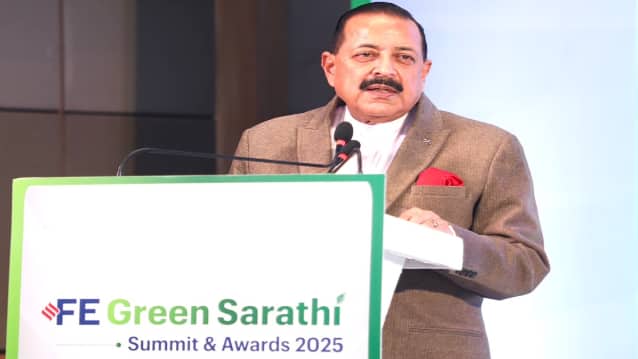
India’s transition to green and clean energy is no longer a matter of debate or environmental positioning but a necessity driven by economic realities, strategic considerations and geopolitical shifts, Union Minister of State (Independent Charge) for Science & Technology and Earth Sciences Dr Jitendra Singh said at the FE Green Sarathi Summit and Awards 2025.
Speaking at the event in New Delhi, Singh said that if India intends to sustain its growth trajectory, there is “no other way” but to move ahead with green energy. He underlined that the rationale for this transition goes beyond science, extending into economics, geopolitics and alignment with the long-term national goals repeatedly outlined by Prime Minister Narendra Modi.
Singh said discussions on whether to adopt clean energy had become redundant, as the global consensus now recognises energy transition as central to sustainable growth and economic resilience. He added that reducing dependence on fossil fuel imports is also critical for strengthening India’s self-reliance, especially at a time when even traditional energy-exporting nations are diversifying their own energy portfolios.
Also read: Climate for change: Indian businesses respond to sustainability pressures
Cautioning against viewing energy transition through isolated trends or buzzwords, Singh said the shift must be approached in a “wholesome fashion”. While electric vehicles, artificial intelligence and other emerging technologies dominate public discourse, he argued that such buzzwords often have limited shelf life. Drawing a parallel with the evolution of artificial intelligence towards an “AI plus human intelligence” approach, he said India’s energy strategy too must evolve into a hybrid model that balances efficiency, cost and reliability.
According to the minister, different energy sources should not be assessed through the lens of preference or exclusion, but based on their suitability for specific applications. While renewable energy will form a significant part of India’s energy mix, he noted that sectors such as data centres, artificial intelligence and advanced computing require stable, uninterrupted power. In such cases, nuclear energy will continue to play a critical role.
Also read: COP30: India’s turn to show leadership in climate transition goals
Referring to India’s clean energy commitments, Singh recalled Prime Minister Modi’s announcement of a Net Zero target for 2070 and the government’s resolve to scale up nuclear power capacity to 100 GW by 2047. He said the future lies in deploying each energy source where it is most effective and economical.
Singh also pointed to mindset as one of the biggest challenges in the transition. He stressed the need to build greater awareness, particularly among younger people, about how to access and benefit from government initiatives. Greater collaboration between the public and private sectors, he said, would also be essential as India opens strategic areas such as nuclear energy and space to private participation.