India’s ambition to reach net-zero emissions by 2070 hinges on a fundamental shift in how its manufacturing economy operates. At the heart of this transition lie micro, small and medium enterprises (MSMEs), which form the backbone of the country’s industrial output, employment and supply chains. While intent to act on sustainability is growing, the real challenge for MSMEs lies in translating ambition into action -- understanding where their emissions originate, how to measure them, and how to reduce them in ways that also strengthen competitiveness.
These questions took centre stage at the FE Emerging Business Growth Workshops’ latest edition held recently in Jaipur, in collaboration with the We Mean Business Coalition and the SME Climate Hub. The half-day summit brought together MSME leaders, industry associations, sustainability practitioners, and financiers to discuss how climate action in manufacturing is evolving from a compliance exercise to a business requirement.
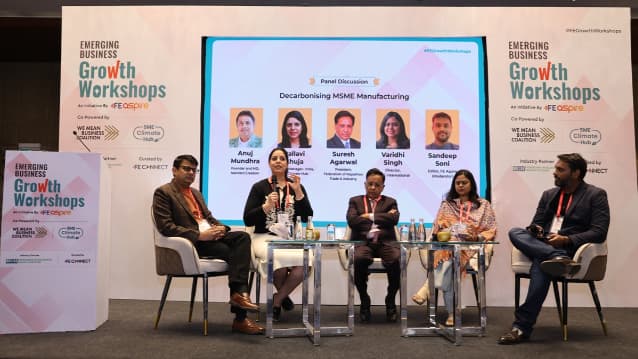
Opening the discussion on decarbonising MSME manufacturing, Pallavi Ahuja, Country Manager for India at SME Climate Hub, framed sustainability as a question of preparedness. “Today, we need to talk about how environmental challenges impact our businesses and how we plan for them,” she said.
While MSMEs are often aware of how climate and environmental changes affect operations, costs and markets, she pointed out that the more pressing issue is readiness. “Small businesses are more vulnerable to climate risks, but now there are tools and resources openly available, designed for MSME leaders to make responsible and informed business decisions," Ahuja added, underlining the need to move from awareness to action.
That shift, several speakers agreed, will demand a stronger focus on innovation and capability building. Suresh Agarwal, President of the Federation of Rajasthan Trade & Industry, flagged India’s limited investment in research and development as a structural concern. “We spend too little on R&D in India,” he said, arguing that technology-led innovation has been central to manufacturing competitiveness in other economies. Linking efficiency with environmental outcomes, Agarwal noted, “The more we progress, automatically, our carbon emissions also will reduce.”
At the enterprise level, speakers highlighted how sustainability often begins with operational choices rather than grand strategies. Anuj Mundhra, Founder and Managing Director of garment manufacturer Nandani Creation, spoke about investments in learning, process optimisation and digital systems. “Packaging is a big part of our garments’ business,” he said, noting that online sales also bring high return rates of 40–45 per cent, largely due to sizing issues. Reducing packaging waste and implementing ERP systems to make factory operations paperless, Mundhra explained, were steps aimed at lowering costs while improving efficiency.
The competitiveness argument became sharper when the discussion turned to global sourcing and compliance standards. Varidhi Singh, Director at CUTS International, pointed out that while Rajasthan’s garment industry has adopted measures such as water recycling, global brands continue to source from other neighbouring countries where sustainability practices are more deeply embedded.
“Even though cities like Bhilwara are huge garment manufacturing hubs, global brands source from other countries like Bangladesh and the Philippines,” Singh said, adding that Indian MSMEs need to adopt sustainability measures proactively rather than wait for regulatory mandates if they want to remain globally competitive.
A crucial enabler of this transition, speakers stressed, is measurement. Swapna Patil, India Program Lead at SME Climate Hub, underscored that MSMEs cannot reduce what they do not track. Patil walked participants through how they can begin this journey in a structured and practical way, explaining that MSMEs can use the SME Climate Hub platform to calculate their emissions and receive a clear emissions report.
“When MSMEs start tracking emissions, it becomes easier to respond to stakeholders, take the right actions, plan future needs, access the right support, and stay competitive,” she said. Emissions data, she noted, also enables businesses to communicate more effectively with buyers, financiers and partners—an increasingly important factor in scaling operations.
The conversation then shifted from factory floors to value chains, with a panel on building climate-resilient supply chains. Dr Ajay Data, Managing Director of Data Group of Industries, highlighted the long-term economics of sustainability investments. “If you invest in the right sustainable technology for cheaper and renewable sources of power, you may spend more capital now but will save much more in the long term,” he said, framing resilience as a business decision rather than a cost burden.
From an industry body perspective, DS Bhandari, Senior Vice President at the Rajasthan Chamber of Commerce and Industry, observed that awareness alone may not be enough to drive behavioural change. “Self-awareness is one thing on carbon emissions. Unless the government or buyers incentivise appropriately, MSMEs will not be cognisant about it,” he said, adding that the benefits of sustainability need to be communicated more clearly to enterprises and society.
Rajiv K Chawla, Chairman of IamSMEofIndia and JaiRaj Group, offered a blunt assessment of the risks of inaction. “Just because your business is small in size, you need to stop citing lack of resources as a reason to act on a problem,” he said, warning that MSMEs using sustainable practices will increasingly replace those that do not, as compliance and customer expectations tighten.
The final piece of the puzzle -- finance -- was addressed in a fireside chat on financing green and sustainable MSMEs. SS Pujari, AGM for Rajasthan at Canara Bank, explained that lenders are paying closer attention to sustainability-linked risk profiles. “Bankers also have a social responsibility,” he said, noting that banks are more willing to fund low-risk proposals, including enterprises with recognised certifications or those operating in eco-friendly clusters and zones.
Taken together, the discussions in Jaipur reinforced a clear message: for manufacturing MSMEs, sustainability is no longer separate from growth. Measuring emissions, improving efficiency and building resilient supply chains are fast becoming core business capabilities -- essential not only to India’s net-zero journey, but also to strengthening the global competitiveness of Indian enterprises.